
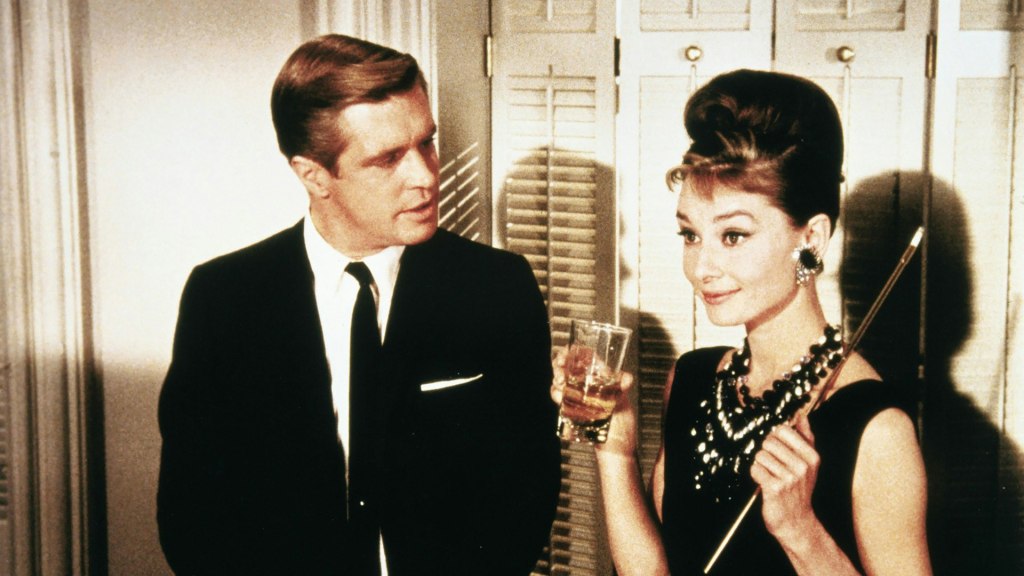
Breakfast at Tiffany’s is a film grounded in romance. Holly Golightly’s life is portrayed as a glamorous and seemingly never-ending pursuit of independence and wealth, while Paul Varjak largely exists to be her romantic foil. Tangerine is quite a different film, telling the story of two black, transgender sex workers—Alexandra and Sin-Dee—as they navigate the unforgiving streets of Hollywood on Christmas Eve. While Tangerine and Breakfast at Tiffany’s both offer portrayals of characters involved in sex work, Breakfast at Tiffany’s ultimately fails to break free from the mold of the typical romance film while Tangerine evokes a sense of gritty realism that highlights the stark differences in privilege and opportunity that stem from the effects of intersectionality of identities.
Most romance films, especially romantic comedies like Breakfast at Tiffany’s, adhere to the same structure: “Two people meet, have a conflict in their way, and reunite to live happily ever after.” Where Breakfast at Tiffany’s differs from the typical rom-com is in the background of the two main characters. Both are sex workers in one way or another—Holly can be most closely described as an escort, while it’s implied that Paul is a “kept man” — “someone who does not work but is instead given money and a place to live by the person she or he is having a sexual relationship with.” The main plot and ending of Breakfast at Tiffany’s reflects a sort of cliche “conflict, then happily ever after” in love, while failing to address anything deeper.
Truman Capote, who was the author of the book that the film is based on, was famously critical of the film for its lack of nuance and overly romanticized storyline. For example, Holly Golightly’s character’s background is sort of glossed-over in the film. But in the book, “Holly is described as having experienced much strife before moving to New York…In Texas, after escaping cruel foster parents, she was taken in by Doc Golightly, who married the child when she was 14…[she] changed her name to Holly and moved away, sustaining herself by dating rich men.” Additionally, the Paul character did not even exist in the book. Instead, there was a silent, nameless narrator whose role in the film was solely marked by his interactions with Holly. The comparative lack of background for Holly and the addition of Paul in the film change the meaning of the story by romanticizing the plot and minimizing the importance of how and why Holly got to be where she was (living glamorously in Manhattan as an implied escort).
Throughout Breakfast at Tiffany’s, Holly is portrayed as a flighty class-ascendant who enjoys (or more accurately, chases) the Manhattan high life and its trappings, and avoids commitment and vulnerability at all costs. There is an air of melancholy behind her character, which the viewer gets a peek at every now and then in the film. For example, while sleeping in bed with Paul, she has a nightmare about her brother Fred in danger and quickly leaves once Paul asks why she was crying. Her insistence in calling Paul by her brother’s name, Fred, also makes the viewer wonder how she conflates familial and romantic relationships. However, these instances are characterized more as quirks in Holly’s character that are meant to explain her commitment issues. At the end of the film, after much conflict, Holly and Paul reunite—they have one final argument in which she throws out her cat (who she calls “Cat”), Paul leaves, and then she runs after Paul in the rain and they find Cat. In what is probably the greatest romantic trope, they kiss in the rain to end the film and presumably live happily ever after. This fairytale ending reinforces the romantic nature of the film and reflects limitations of media in this time period.
Sex (and by extension, sex work) was taboo in the 1950s—the period immediately preceding the film’s release—while the 1960s and 1970s represented a liberalization on attitudes toward sex. Breakfast at Tiffany’s subverted norms and expectations of the time by even alluding to sex work. However, even though the film was subversive for the time, it doesn’t quite hold up in modern-day thought and discussion (in which realism is perhaps more valued). By favoring romance over addressing any of the less savory aspects of Holly’s life, Breakfast at Tiffany’s diminishes the struggles that she might have faced in her troubled past and in her present day life.

In stark contrast, the film Tangerine is rooted in a raw, unfiltered realism that places the viewer in direct witness of the harsh realities of the characters’ lives. Like Holly and Paul in Breakfast at Tiffany’s, main protagonists Alexandra and Sin-Dee are sex workers. However, they are also Black transgender women who spend their time not in ritzy areas of Manhattan, but on the gritty streets of Hollywood. Identity is central to the plot of Tangerine—it colors Alexandra and Sin-Dee’s every interaction, and it means that they are always vulnerable in some way. The film portrays on-street sex work, pimping, brothels, violence, and transphobia as a normal part of Alexandra and Sin-Dee’s lives.
Black trans women are among the most vulnerable people in America—they have disproportionately high unemployment rates which push them onto the streets, low income when they are employed, high rates homelessness, and they are vulnerable to violence stemming from sex work or even just existing. This is due to the role that intersectionality—“the way in which different types of discrimination are connected to and affect each other”—plays in their existence. Alexandra and Sin-Dee face discrimination for both their identities as black people and as trans women, not to mention stigmatization for sex work. Tangerine accurately gets this harsh reality across to the viewer, whereas Breakfast at Tiffany’s smooths out the rough edges of its characters involvement in sex work.
Perhaps the biggest differences between the characters in the two films are when it comes to privilege and opportunity. Holly has made a life for herself by “dating” wealthy men while Paul is supported by “2E.” Both live comfortably as white Americans in the early 1960s, though again, an argument can be made that their portrayals were sanitized and the true reality of sex workers at the time was perhaps not so peachy. On the other hand, for Alexandra and Sin-Dee, life is more about survival and resilience in the face of adversity. Their lives as black trans women leave little to no room for chasing wealth and happiness as Holly Golightly does.
Tangerine has a bittersweet ending: after it’s revealed that Alexandra betrayed Sin-Dee, Sin-Dee tried to walk away from Alexandra. As she was walking, she was assaulted by people in a passing car who targeted her based on her identity, leaving her emotionally destroyed. Afterwards, Alexandra comforts her and even takes her wig off to give to Sin-Dee (whose wig was ruined in the assault)—a strong gesture of friendship and solidarity . This was a touching scene that ended the film on an uplifting note, but even so, it illustrates the immensely different realities that the characters face in each film. Tangerine embraces rawness and struggle, while Breakfast at Tiffany’s leans into romance to the detriment of realism. Because of this, the former was more successful than the latter in telling the stories of sex workers, grounding its plot in lived experience instead of a fairytale love story.
 Tyler Fouch
Leave a comment