
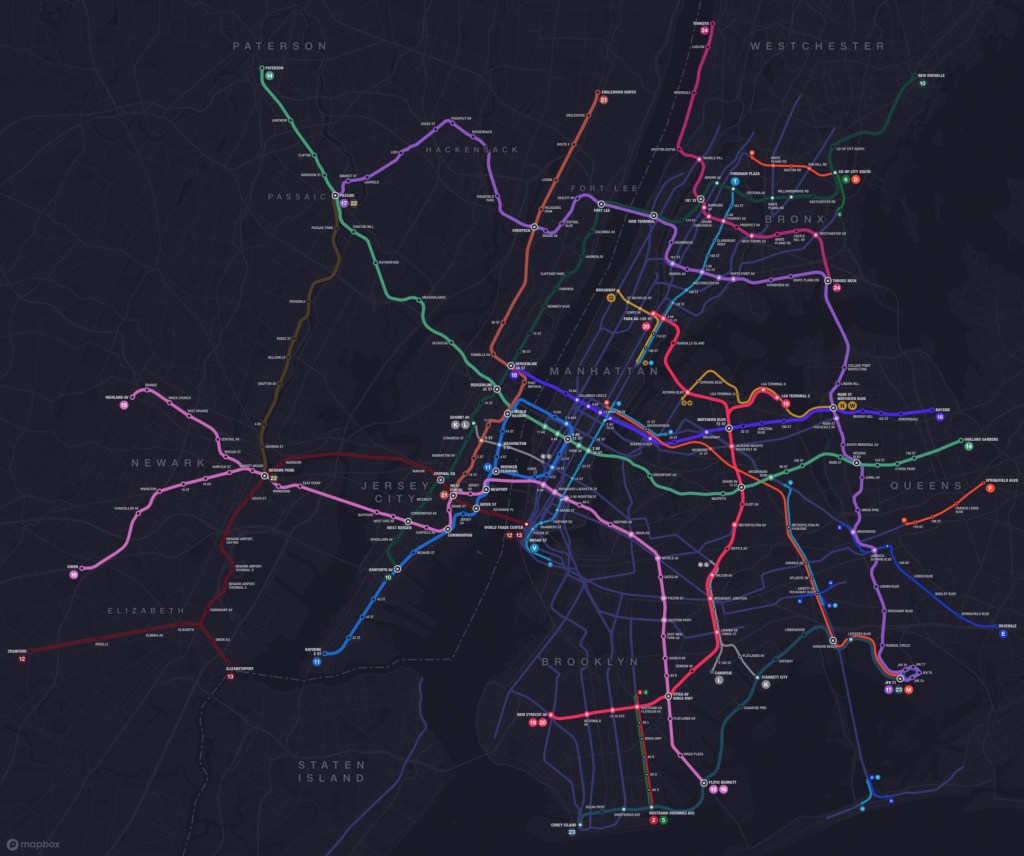
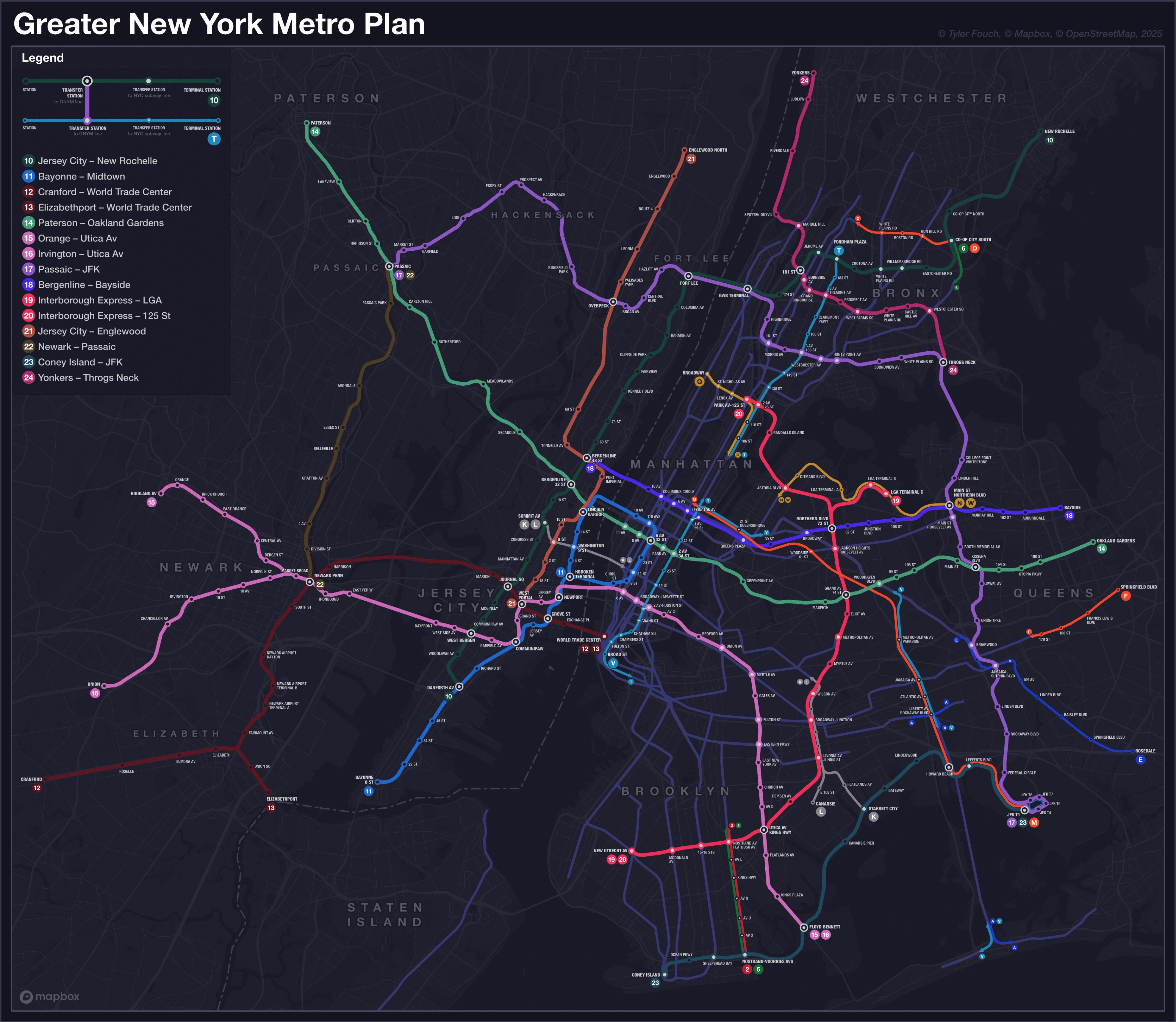
After several months of fitful work on this plan, it’s finally arrived at a place where it’s starting to feel complete. In addition to the brand-new Greater New York Metro (GNYM) lines, I’ve penciled in several additional extensions/changes to existing subway lines. Nothing crazy, just what made sense to me at the time. The new GNYM lines included in this iteration of the plan are a bit more out-there in terms of practicality, but would do wonders for regional travel (see: Line 23 facilitating much quicker access to JFK Airport from South Brooklyn). Look at the updated map and read more about the new changes below.
Central Queens and the LIE
In prior versions of this plan, I ended Line 14 (the Paterson line) in Manhattan because I wasn’t quite sure where to take it. There were two main options: take the LIRR’s Lower Montauk Branch and send it to Jamaica for another Midtown–Jamaica option, or route it along the Long Island Expressway towards eastern Queens. The LIE option just made more sense, as it hits more significant destinations while also providing rail access to underserved areas.
Starting from the 2 Av/34 St station, the line will cross the East River, join the Lower Montauk Branch right-of-way for a while at-grade, before transitioning to run elevated along the Long Island Expressway. It will remain along the LIE until its terminus. Trains will first stop at Greenpoint Avenue, mainly to provide a transfer opportunity for buses to Greenpoint and Sunnyside. This stop isn’t completely necessary due to its industrial surroundings, but I chose to include it because there would otherwise be a miles-long gap between Manhattan and the next stop, Maspeth. Maspeth station will be located adjacent to the neighborhood’s main business district along Grand Avenue. Although residents of the area probably wouldn’t like it, the construction of the station and a simple rezoning would immediately result in a boom in development in the area due to its proximity to Manhattan.
The next two stops, Grand Av–74 St and Woodhaven Blvd, will be interchange stations with Lines 19-20 and the Queens Boulevard Line respectively. I decided to skip a transfer to the super-express M train in the area due to the proximity of the Woodhaven Blvd station and the fact that riders can transfer to the V for the same purpose. Woodhaven Blvd station is a significant one on this line, serving a major retail area and providing connections to many areas of Queens via the QBL. At this point, it would also probably be fitting to convert the QBL station to an express stop.
Continuing eastward (still elevated), the line stops at 99 St and 108 St stations which serve densely-populated residential areas along the LIE (southern Corona, northern Rego Park, northern Forest Hills), before crossing Flushing Meadows–Corona Park into the more suburban areas of eastern Queens. There will be a stop at Main St, then an interchange station with Line 17 at Kissena Blvd. Finally, trains will stop at major arterials 164 St, Utopia Pkwy, and 188 St, before terminating in Oakland Gardens at Springfield Blvd.
This extension of Line 14 fills in significant gaps in the rail system, providing easier connections from the areas it serves to not just Manhattan, but the rest of the city as well.
Yonkers and Tremont Avenue
Another conundrum I faced while thinking up this plan was how to serve Yonkers. I didn’t want to extend any existing lines as that would make for pretty long rides for Yonkers passengers wanting to go downtown without really benefiting riders with other destinations. Ultimately, I thought the best option would be to combine Yonkers service with a crosstown Bronx line along the Tremont Av corridor, for a new Line 24.
To be a little more cost-effective and realistic, Line 24 follows the Metro-North Hudson Line right-of-way from Yonkers to south of Marble Hill, making the same stops. Metro-North trains would potentially then be able to skip some of these stops to speed up travel times to/from north of Yonkers, though that might not be popular with suburban commuters in Riverdale and Spuyten Duyvil.
Around Fordham Rd, the line will branch off of the Hudson Line and curve underground for three shortly-spaced major interchange stations: 181 St (Line 10), Burnside Av (4 train), and Grand Concourse–Tremont Av (B and D trains). Trains will run under Tremont Av from Grand Concourse to Westchester Square. Stations will be located at 3 Av (interchange with the T train), Prospect Av, West Farms Square (interchange with the 2 and 5 trains), White Plains Rd, Castle Hill Av, and Westchester Square (interchange with the 6 train). After this, the line will transition to an elevated alignment along the Hutchinson River Pkwy and terminate at an interchange with Line 17 in Throgs Neck.
Line 24 will provide much-needed rapid transit crosstown service to the Central and South Bronx while also bringing urbanized areas of Yonkers into the rapid transit fold.
One More Orbital…Along the Shore
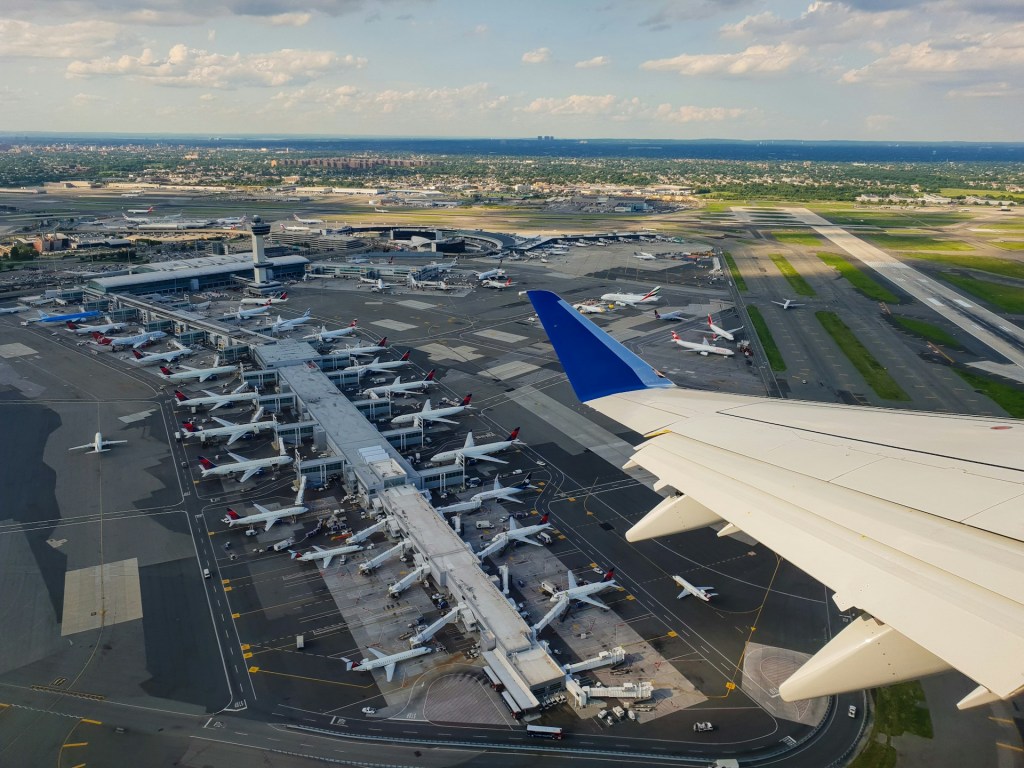
The jury is still out on whether this one is entirely necessary, but even with the Interborough Express (Lines 19 and 20), Brooklyn–Queens orbital travel seemed to be lacking. For example, to get from somewhere like Gravesend to JFK Airport would require a somewhat circuitous three-transfer trip — entirely unappealing to a traveler carrying heavy luggage for a flight. This new Line 23 will start at the Coney Island hub and travel elevated along the Belt Parkway to JFK.
After Coney Island, trains will stop at Ocean Pkwy, Sheepshead Bay (interchange with the B and Q trains), Nostrand-Voorhies Ave (interchange with the 2 and 5 trains), Floyd Bennett Field (interchange with Lines 15 and 16), Canarsie Pier, Starrett City (interchange with a rerouted L train), Gateway, and Lindenwood. After this point, the line will join the M train’s route into JFK, ending at Terminal 1 where riders can transfer to loop trains within the airport.
Spur to the Oranges and Extension to Union
I still felt I could do better about serving the areas surrounding Newark with my plan — specifically the Oranges. Prior to this iteration I felt that Orange and West Orange could be satisfactorily served by more frequent regional rail service along the NJ Transit Morristown Line’s local stops. There are a few reasons why I realized this might not work: one, you’d have to work around scheduling conflicts with NJ Transit service on the three-track line; two, it would be less integrated with the rest of the rapid transit network than a traditional rapid transit line would be; and three, it wouldn’t serve the core of downtown Newark like rapid transit line could (Morristown Line trains run through Newark Broad Street on the periphery of downtown).
So, what are the options if we can’t do regional rail? The Newark Light Rail could be branched west to go to the Oranges, but this would likely be a slower option. The L train could be extended from Summit Av station to run alongside NJ Transit trains through Secaucus and to the Oranges, but this would run into the same issue of not serving the core of downtown Newark as the regional rail idea. The option that made the most sense to me was to split Line 15 into two branches (Lines 15 and 16), with Line 15 continuing northwest from Market-Broad station. The new branch will run roughly under Market St, stopping at Bergen St and Central Av, before rising above ground to run along the NJ Transit Morristown Line to Highland Av (making the same stops).
There should be enough room for elevated rapid transit tracks along the Morristown Line right-of-way for most of the route, but some property would likely need to be taken in some areas. A further extension to South Orange could be penciled in as well, but from a cost-benefit analysis point of view it probably wouldn’t be the most effective use of funds considering lower population density surrounding the Mountain and South Orange stops and the wealthier area’s likely NIMBY tendencies.
Moving a bit southward, the newly-designated Line 16 (the original route of Line 15 to Irvington) will see a two-stop extension to Chancellor Av in Irvington and Morris Av in Union, where it will terminate. On paper, this extension might not make all that much sense, but Union is a decently urban township with a prominent central business district, and Morris Av has great potential for a bus rapid transit line connecting to Kean University and Elizabeth.
Changes and Extensions to Existing Subway Lines
E Train to Southeast Queens
This long-proposed extension will finally come to fruition, extending to Rosedale with stops at 109 Av, Linden Blvd, Baisley Blvd, and Springfield Blvd. Trains will use the current LIRR Atlantic Branch right of way, with LIRR service shifted to the Babylon/Montauk Branch. The E train extension will bring subway service to the Southeast Queens rapid transit desert and drastically reduce travel times to other points in the city and beyond.
F Train East on Hillside Av
Another long-proposed extension, this will bring the F train east from 179 St along Hillside Av. Stations will be more widely-spaced, at 188 St, Francis Lewis Blvd, and Springfield Blvd. This extension will relieve the heavily-used bus corridor along Hillside Av.
2 and 5 Trains South Along Nostrand Av
There were two things I could have done with this: Branch the line so that one service travels along Flatbush Av to King Plaza and the other stays on Nostrand Av, or just keep both of them on Nostrand. I not-so-confidently decided to just keep both the 2 and 5 trains on Nostrand Av. My thoughts were that a junction south of Flatbush Av-Brooklyn College would add too much complication for what might only be a 2-stop branch, and that riders bound for destinations on Flatbush Av (including Kings Plaza) could either transfer to a bus or take the Interborough Express over to Utica Av and transfer to Lines 15 or 16 to Kings Plaza.
Therefore, the 2 and 5 trains will continue south to Voorhies Av, with intermediate stops at Av L, Kings Hwy, Av R, Av U, and Av X. The terminus at Voorhies Av would provide a transfer opportunity to Line 23. This extension would likely be elevated south of Kings Hwy, where Nostrand Av widens significantly.
Northern Bronx Crosstown D Train
The D train was originally intended to continue east across the Bronx River from its current-day terminus at Norwood-205 St. This extension would be in a similar vein, but unlike the original idea which would have sent trains northeast along Boston Rd, it would travel east to Co-op City. After crossing the river, the line will intersect with the 2 train at White Plains Rd and Burke Av, then stopping at Boston Rd before intersecting with the 5 train at Gun Hill Rd. Finally, it will terminate at Co-op City South. This extension’s purpose is more for system connectivity than ridership.
A Branch to Starrett City
Finally, the Canarsie Line (present-day L train) will split south of New Lots Av station. A new K train branch will curve east onto Linden Blvd and then south onto Pennsylvania Av, where it will stop at Flatlands Av and at the southern end of Starrett City at an interchange with Line 23. An infill station may be added later at the midpoint between these two stops. The L train would continue serving E 105 St and Canarsie-Rockaway Pkwy stations.
Final Words
I’d love to say this is the complete plan, but I’ll probably continue adding and tweaking things as ideas come to me in the future. That being said, I’m happy with the way it has turned out, however unrealistic the plan be!


Leave a Reply